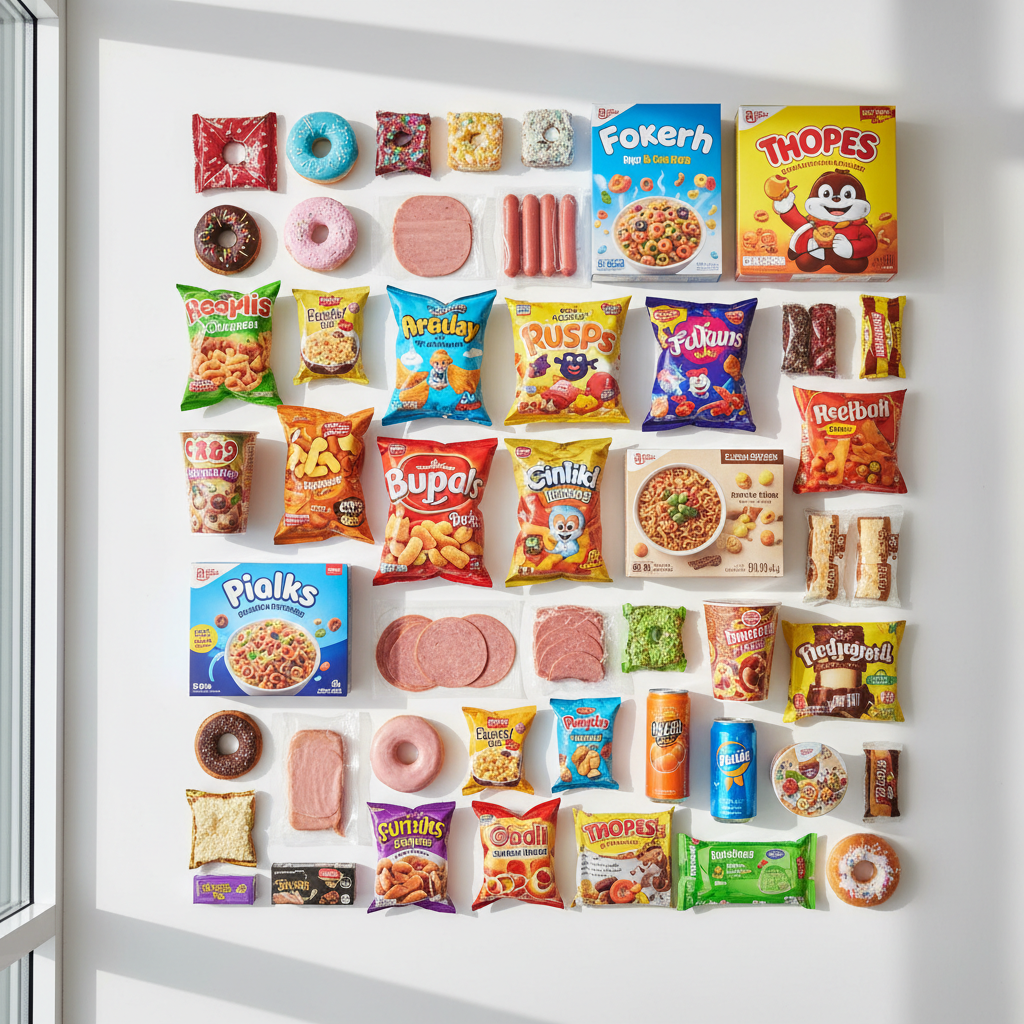
Ultra-Processed Foods (UPF): The Research You Need to Read
Summary
Ultra-processed foods now account for more than half of caloric intake in the UK, US, and Australia. A wave of large-scale studies links UPF consumption to cancer, cardiovascular disease, type 2 diabetes, depression, and premature death — even after controlling for diet quality.
Ultra-Processed Foods (UPF): Understanding the Evidence
The term Ultra-Processed Food (UPF) was formally defined by epidemiologist Carlos Monteiro and the NOVA classification group at the University of São Paulo. Unlike earlier nutrition frameworks that focused on individual nutrients (fat, sugar, salt), NOVA classifies foods by their degree and purpose of processing — a framework that has generated one of the most productive areas of nutrition research in the past decade.
Note: This article summarises epidemiological and nutritional research for consumer information purposes. It is not dietary advice. For personalised nutrition guidance, consult a registered dietitian.
The NOVA Classification System
NOVA divides all foods into four groups:
| Group | Description | Examples |
|---|---|---|
| Group 1 | Unprocessed or minimally processed | Fresh fruit, vegetables, meat, fish, eggs, milk, plain yoghurt, dried legumes |
| Group 2 | Processed culinary ingredients | Olive oil, butter, flour, sugar, salt — used to prepare Group 1 foods |
| Group 3 | Processed foods | Canned fish/vegetables, cured meats, artisanal bread, cheese, wine, beer |
| Group 4 | Ultra-processed foods | Industrial formulations with ingredients not typically used in home cooking |
What distinguishes Group 4 (UPF):
- Contains ingredients absent from home kitchens: hydrolysed proteins, maltodextrin, modified starches, interesterified fats, invert sugar syrup
- Contains additives with a cosmetic or sensory purpose: artificial flavours, colours, emulsifiers, sweeteners, anti-caking agents
- Produced through industrial processes not reproducible domestically: extrusion, moulding, pre-frying, micro-encapsulation
Common UPF examples: Packaged breakfast cereals, instant noodles, carbonated soft drinks, flavoured yoghurts, crisps and savoury snacks, mass-produced bread and buns, chicken nuggets and fish sticks, plant-based meat alternatives, ready meals, protein bars, meal replacement products.
Note: NOVA classification can be counterintuitive. Many products marketed as 'healthy' (low-fat yoghurts with sweeteners and thickeners, some granola bars, flavoured plant milks) fall into Group 4 by formulation.
Scale of UPF Consumption
Population data underscore why the UPF evidence base matters at a public health level:
- United Kingdom: UPF accounts for approximately 57% of daily caloric intake (Monteiro et al., Public Health Nutrition, 2018; updated UK Biobank data 2023)
- United States: Approximately 58% of calories from UPF (Martínez Steele et al., BMJ Open, 2016)
- Australia: ~42% of daily energy from UPF (Machado et al., Nutrients, 2019)
- Brazil: ~22% — lower than high-income countries but rising
The Evidence Base: Key Studies
Cancer — Fiolet et al., 2018 (BMJ) This prospective cohort study followed 104,980 French adults in the NutriNet-Santé cohort. A 10-percentage-point increase in UPF consumption was associated with a 12% increase in overall cancer risk and an 11% increase in breast cancer risk. Associations persisted after adjustment for overall dietary quality, BMI, and physical activity.
Limitations: Observational design; dietary data self-reported; confounding by lifestyle factors not fully eliminable.
Cardiovascular Disease — Rico-Campà et al., 2019 (BMJ) A prospective analysis of 19,899 Spanish adults from the SUN cohort found that individuals in the highest quartile of UPF consumption had a 62% higher risk of all-cause mortality than those in the lowest quartile. Each additional daily serving of UPF was associated with an 18% increased risk of all-cause mortality.
Limitations: Residual confounding possible; self-reported dietary data.
Type 2 Diabetes — Meta-analysis, Diabetes Care, 2023 A systematic review and meta-analysis of 10 prospective cohort studies (>1.2 million participants) found UPF consumption significantly increased T2D risk, with a dose-response relationship. The association remained after adjusting for total energy intake and other dietary quality measures.
Mental Health — Lane et al., 2022 (Public Health Nutrition); Adjibade et al., 2019 (Nutritional Neuroscience) Multiple cohort studies have found associations between high UPF consumption and depressive symptoms. A 2024 umbrella review in BMJ analysing 45 studies found high UPF intake was associated with a 22% higher risk of depression, a 40–66% higher risk of anxiety, and adverse sleep outcomes.
All-Cause Mortality — Kliemann et al., 2024 (Lancet Regional Health – Europe) A 2024 prospective analysis using UK Biobank data (197,426 participants, 10-year follow-up) found each 10% higher UPF intake was associated with a 3% increased all-cause mortality risk, with associations specific to certain UPF subcategories — particularly processed meat, sugar-sweetened beverages, and savoury snacks.
Why Might UPFs Be Associated With These Outcomes?
Researchers debate whether harm comes from specific additives, the overall dietary pattern, or indirect effects. Proposed mechanisms include:
1. Food additive effects on the gut microbiome Emulsifiers (polysorbate 80, carboxymethylcellulose), artificial sweeteners, and preservatives have been associated with microbiome disruption in animal and some human studies. See the companion article on food additives and the gut microbiome for details.
2. Displacement of nutrient-dense foods High UPF consumption correlates with lower fibre, micronutrient, and antioxidant intake. Some researchers argue the health associations are primarily attributable to poor overall diet quality rather than UPF-specific effects.
3. Overconsumption engineering UPFs are formulated for high palatability that may override satiety signals. A randomised controlled trial (Hall et al., 2019, Cell Metabolism) found participants assigned to an ultra-processed diet consumed 508 kcal/day more than those on an unprocessed diet — even when nutrient composition was matched — and gained weight over a two-week period.
4. Packaging contaminant migration BPA, phthalates, and PFAS from food contact materials can migrate into food — a concern elevated with processed foods that undergo high-heat industrial processing or long storage in plastic packaging.
5. Advanced glycation end-products (AGEs) Industrial processing techniques (high-heat extrusion, pre-frying) generate AGEs at higher levels than home cooking. AGEs are associated with inflammation and metabolic dysfunction in animal and human studies.
Scientific Debate and Limitations
The UPF field is not without controversy:
- NOVA classification subjectivity: Researchers have criticised NOVA for inconsistent categorisation — some fermented dairy products, traditionally processed foods, and fortified foods are classified as UPF despite evidence of health benefits
- Confounding: UPF consumption correlates with lower socioeconomic status, higher stress, less sleep, and lower physical activity — factors independently associated with poor health outcomes. Adjusting for these is methodologically challenging
- Causality not established: All large-scale UPF studies are observational. Hall et al. (2019) is the only randomised controlled trial to date specifically testing UPF vs. unprocessed diets — conducted over just two weeks in 20 inpatient participants
- Heterogeneity of UPF: A sugar-sweetened beverage and a fortified meal replacement shake are both UPF by NOVA criteria but have very different nutritional profiles
The WHO, UK NHS, and several national dietary guidelines now recommend reducing UPF consumption, but most stop short of specific numeric limits given the evidence limitations.
Practical Shopping Guidance
Identifying UPFs on labels — the NOVA indicator list: If a product ingredient list contains any of the following, it is likely a UPF:
- Hydrolysed protein, soy protein isolate, gluten
- Maltodextrin, dextrose, lactose, invert sugar, high-fructose corn syrup
- Interesterified or hydrogenated oils
- Modified starches (E1400 series)
- Flavour enhancers (E621 monosodium glutamate, E627, E631)
- Artificial flavours, artificial colours (E102, E110, E122, E124, E129)
- Emulsifiers (E433 polysorbate 80, E466 CMC, E407 carrageenan, E471–E476)
- Non-sugar sweeteners (E950–E960 range: acesulfame K, aspartame, sucralose, stevia)
- Foaming, anti-foaming, bulking, or glazing agents
Shopping framework:
- Check ingredient count — products with >5–6 ingredients that include any of the above indicators are likely UPF
- Look for ingredient recognisability — can you identify all ingredients as real foods or basic culinary ingredients?
- Compare within category — between two breads, two yoghurts, or two sauces, the one with fewer additives and shorter ingredient list is typically closer to Group 3 (processed) than Group 4 (ultra-processed)
- Prioritise Group 1 and 2 foods as staples — cook from basic ingredients when time allows; batch cook for convenience
- Use ScoreKart — scan packaged food products to see which additives are present, their E-number classifications, and regulatory status
UPF subcategories with strongest evidence for harm: Based on the Kliemann et al. (2024) UK Biobank analysis and other meta-analyses, certain UPF subcategories show more consistent associations:
- Processed and reconstituted meat products
- Sugar-sweetened beverages
- Savoury packaged snacks (crisps, crackers with long additive lists)
- Packaged sweet desserts and confectionery
Other UPF subcategories — such as fortified breakfast cereals, some ready meals, or plant-based dairy alternatives — show less consistent associations and may have nutritional benefits that offset processing concerns.
ScoreKart flags UPF-indicator additives — emulsifiers, artificial sweeteners, flavour enhancers, colours, and preservatives — in every food product scan, alongside EU, FDA, and Codex Alimentarius regulatory status, so you can make informed decisions at the point of purchase.
Related Topics: